
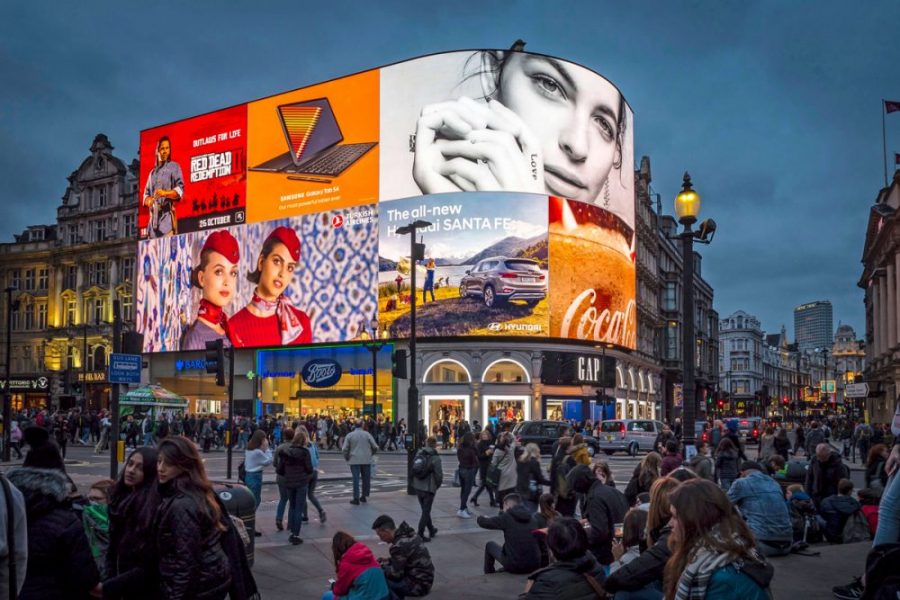
Digital Billboard Advertising UK
Digital screens across the UK: shopping centres, roadsides, stations, city centres. Change your creative mid-campaign, target different dayparts, run video where the screen allows it, and skip print costs entirely. Digital took two-thirds of UK out-of-home revenue in 2025 for a reason. Campaigns from £450 per 2 weeks (1-in-6).
Digital Billboard Advertising (DOOH): The Short Answer
Digital billboard advertising, part of digital out-of-home (DOOH) or digital outdoor advertising, means adverts on screens in public places: roadside billboards, bus shelters, shopping centres, stations and the Tube. You buy a share of a screen's loop, usually 1 slot in 6 (a 10-second ad in a loop of about a minute), in 2-week cycles. Digital 6-sheets start from £450 for 2 weeks, and a roadside digital 48-sheet costs £1,230 to £1,590 per screen (from £955 in Sheffield), with no print cost. Programmatic DOOH is bought by audience and impressions instead, priced on request. Some networks have a minimum order of £1,000 + VAT. Prices exclude VAT.
£1.44bn
UK OOH Revenue 2025
67%
Digital Share of UK OOH, 2025
1-in-6
Standard Share of Time
£450
From / 2 Weeks (1-in-6)
What Is Digital Billboard Advertising?
Digital billboard advertising (DOOH) uses LED and LCD screens, often called digital or electronic billboards, to display your ads in high-traffic public locations. Same locations as traditional billboards, but with the added ability to run video, swap creative within hours, and target by time of day.
Digital out-of-home advertising, digital outdoor advertising and DOOH all mean the same thing: adverts on screens outside the home instead of printed posters. Digital billboards are the best-known part of it. It also covers OOH screens in shopping centres, stations, airports and bus shelters, programmatic DOOH (bought by audience across many screens) and interactive OOH (posters and screens people can respond to). For the wider picture, see what OOH advertising is and all outdoor advertising formats.
Digital advertising billboards now sit on roadsides, in shopping centres, at train stations, on Underground platforms, at airports and in bus shelters. UK out-of-home revenue reached £1.44bn in 2025, the highest ever, and two-thirds of it (67%) was digital (UK out-of-home industry figures, collated by PwC). Digital is growing faster than out-of-home as a whole: DOOH revenue grew 15.9% in the first half of 2026, against 13.7% for all OOH (industry figures, September 2026). That is not hype. That is industry revenue data. More figures are in our UK OOH advertising statistics.
The difference between digital and traditional is flexibility. A printed billboard locks you into one creative for the whole campaign. Digital lets you swap artwork in hours. You can run a breakfast ad at 7am, a lunch promo at noon, and a different creative entirely on weekends. You can react to weather, update pricing, or pull a campaign overnight if you need to. No reprinting. No reinstallation costs.
The screens themselves grab attention in a way static posters struggle to match. They are bright and high-definition, and in shopping centres, stations and on the Tube they often run motion or video. The industry's OutPerform study with Ipsos (2016) found that out-of-home advertising lifts smartphone brand actions by 17%, and by 38% for the top 20 campaigns. People see the screen, then search for the brand on their phone. That online-offline connection is why so many performance-minded brands are shifting budget into DOOH.
We will be honest: digital does not suit every brief. If you want 100% share of voice on a single location, a traditional billboard is better. Your ad is the only one there, 24/7. Digital rotates you with 4-6 other advertisers. But for flexibility, multi-location reach, and the ability to optimise mid-campaign, digital wins.
How Buying Digital Outdoor Advertising Works: By the Slot, the Fortnight or the Impression
Here are the four main ways to buy digital screen time. Most campaigns use direct booking; the others suit tighter targeting, a landmark moment or a one-day burst.
| Question | Direct booking | Programmatic DOOH | Landmark spectacular | Digital AdVan |
|---|---|---|---|---|
| What you buy | A share of time (usually 1-in-6) on named screens you choose | Impressions against an audience, spread across many screens | A share of time on a large, premium screen in a famous spot | A whole moving LED screen with a driver, on the route you choose |
| Booking period | 2-week cycles | Flexible flights, shorter than 2 weeks if needed | 2 weeks; landmark screens such as Piccadilly Circus by the week | By the day |
| Price | Roadside D48 £1,230 to £1,590 per screen (from £955 in Sheffield); D6 from £450 | Priced by impressions (CPM), on request | London from £6,400 per 2 weeks (1-in-6); landmark screens on request | From £999 a day, driver included |
| Best for | Most campaigns: local or national reach on known sites | Precise audiences, times of day and data triggers | Launches and statement moments | One-day or weekend bursts, events and launches |
Price roadside screens in the billboard cost calculator, Tube screens in the Tube cost calculator, or see digital AdVan hire for a day. Some networks have a minimum order of £1,000 + VAT. Prices exclude VAT.
Digital Billboard Costs
Real rates. Prices shift based on screen location, share of voice, and time of year. September to November is peak season and costs go up. January is the cheapest month across the board.
D6 – Digital 6-Sheet
High Street (shopping centres from £530)
From £450 / 2 weeks (1-in-6)
D6 – Digital Bus Shelter
National (London £640 – £745)
£530 – £745 / 2 weeks (1-in-6)
D48 – Digital 48-Sheet
Roadside, London and regional (Sheffield from £955)
£1,230 – £1,590 / 2 weeks (1-in-6)
Digital Spectacular
London
£6,400 – £10,600 / 2 weeks (1-in-6)
Digital Spectacular
Regional cities (Bristol £5,350)
From £4,250 / 2 weeks
Landmark Screens
Piccadilly Circus and similar
Priced by the week, on request
Tube Digital Screens
London Underground D6 / D12
D6 from £950, D12 from £1,760 / 2 weeks (1-in-6)
Rail Station Screens
Major UK stations
D6 from £690 / 2 weeks; large screens on request
Programmatic DOOH
Multi-screen Network
Price on request
Some networks have a minimum order of £1,000 + VAT, and some premium networks have higher minimums. Prices exclude VAT. These are guide rates. Exact pricing depends on the specific screen, share of voice, and booking period. We will give you exact numbers in your quote.
Price a screen in the billboard cost calculator or the Tube cost calculator. More detail: Tube digital screens, bus advertising, bus advertising costs and billboard advertising costs in the UK.
Digital Billboard Formats
Four formats, four different use cases. Small format for footfall, large format for mass reach, spectaculars for impact, programmatic for precision.
D6 – Digital 6-Sheet
From £450 / 2 weeks (1-in-6)
Small screens in shopping centres (from £530), high streets, and bus shelters. You are close to people who are already walking past shops. Brilliant for retail promos, events, and anything where you want to catch someone 10 metres from the point of sale. Two major media owners run most of the D6 network.
D48 – Digital 48-Sheet
From £1,230 / 2 weeks (1-in-6), £955 in Sheffield
Large roadside screens. These are the big ones you see on the A-roads and ring roads. High-def LED panels visible from a distance, hitting drivers and pedestrians on major routes. The bread and butter of DOOH if you want mass reach. Several major media owners operate D48 networks.
Digital Spectacular
London from £6,400 / 2 weeks (1-in-6); regional from £4,250
The showstoppers. Piccadilly Circus, Waterloo Motion, Old Street roundabout, IMAX. These screens are massive, iconic, and they generate earned media on top of paid impressions. People photograph them and post on social. If your campaign needs a statement moment, this is it.
Programmatic DOOH
Price on request
Buy audiences, not sites. Set your targeting, budget, and schedule through a specialist programmatic platform. The platform optimises delivery across thousands of screens. If you already buy programmatic display, this works the same way but on real-world screens.
Why Digital Billboards
Six reasons DOOH is eating traditional OOH's lunch. And they are all practical, not theoretical.
Dynamic Creative
Video, animation, motion graphics. Digital screens support content up to 15 seconds. You can rotate multiple creatives and A/B test designs to see what actually works. A static poster can not do any of that. One limit: under the industry’s roadside planning code, large roadside screens show still images unless the site has consent for motion.
Daypart Targeting
Show a breakfast ad at 7am and a completely different campaign at 6pm. Same screen, different audience, different message. We have had restaurant clients running three different creatives per day. This alone makes digital worth it for time-sensitive promotions.
Change Creative Overnight
New product dropped? Price change? Weather triggered? Update your digital billboard in hours, not the 2-3 weeks it takes to reprint and reinstall a traditional poster. Some programmatic platforms even trigger changes automatically off data feeds.
No Print Costs
A 48-sheet print runs about £80-£120 per poster. If you are running 20 sites, that is £1,600-£2,400 in print alone, plus installation. Digital: £0. Upload a file and you are done. If you are changing creative multiple times, the savings add up fast.
Measurable Results
The industry’s audience measurement gives audience estimates for digital screens across the major networks. Add proof-of-play reports, footfall tracking, mobile device IDs and brand uplift studies, and you can actually measure what DOOH does for you. It is not a guess like it used to be with traditional posters.
Drives Mobile Search
The industry’s OutPerform study with Ipsos (2016) found that seeing out-of-home ads lifted smartphone brand actions by 17%, and by 38% for the 20 best campaigns. People see the screen, pull out their phone, and Google your brand. If you are running digital ads alongside DOOH, the combined effect is significant.
Programmatic DOOH (Programmatic Outdoor Advertising)
Programmatic outdoor advertising buys digital screen time automatically, by audience and impressions, instead of booking named screens for 2 weeks. We plan and buy it for you, priced on request.
How It Works
You set the audience, places, times and budget in a demand-side platform (DSP). Screen owners offer their screens through a supply-side platform (SSP) or exchange. Ads are bought by the impression, priced per thousand (CPM), and play when and where your audience is likely to be.
Deal Types
Open auction: bid against other buyers for available plays. Private marketplace: an invited auction on a set group of screens with a floor price. Programmatic guaranteed: a fixed price and a fixed number of impressions, booked in advance like a direct buy.
Targeting
Location (a radius around your stores, or a list of postcodes), time of day and day of week, and audience profiles from the industry’s audience data. You pay for the impressions you buy, not a fixed 2-week slot, and flights can be shorter than 2 weeks.
Data Triggers
Creative can change with live data: weather and temperature, pollen counts, time of day, live sport and travel updates. Hot drinks when it is cold, sun cream when it is hot, a different message when the trains are delayed.
Proof of Play and Standards
Plays are logged as proof of play, so reports show where and when your ad ran and the impressions delivered. UK out-of-home data standards, set by an industry standards committee, cover this: OpenRTB for real-time bidding, OpenDirect for programmatic direct deals, and Playout, one central place where buyers can see media owners’ playout data.
Programmatic Is Not Always Cheaper
Some people assume programmatic DOOH is the budget option. It can be, but CPMs for premium London screens on programmatic can actually exceed traditional buying. Programmatic is best when you need precision targeting, flexible budgets, or fast activation. For a straightforward 10-screen campaign, traditional buying is often simpler and cheaper.
Interactive Outdoor Advertising (Interactive OOH)
Interactive OOH gives people something to do with your ad: scan it, react to it, or watch it change. Here is what can be booked, and where.
QR Codes
Put a QR code in your artwork and people can scan straight to an offer, a booking page or an app download. It works best where people stand and wait: bus shelters, stations, shopping centres, not fast roads. Use a different link for each format or area to see which screens drove the scans.
Data-Triggered and Countdown Creative
On digital screens, your ad can count down to a launch or a sale, or change with the weather, the time of day or a live score (see programmatic above). One booking, many versions of the message.
Live and Social Content
Some screens can show live feeds, social posts or content made by your customers, where the screen owner allows it. Screen owners set their own rules for live content, so ask us early and we will check the screens on your plan.
Touch, NFC and AR
Some shopping-centre and station screens offer touch, NFC (tap your phone) or augmented reality. What is available changes by site and date, so we check it against your brief and price it on request.
Full Motion and 3D on the Move
The digital AdVan plays full-motion video and 3D anamorphic content on a moving LED screen, from £999 a day, driver included. Good for launches and events, and for a single day or a weekend.
See It in Action
Real campaigns on landmark digital screens, station screens, digital AdVans and billboards. See campaign examples on our case studies page.
Where Are Digital Billboards?
Screens go where the people are. Here is what each environment gives you and who you are reaching.
Shopping Centres
Westfield, Bluewater, Trafford Centre, Bullring. Shoppers already in buying mode. D6 screens near store entrances, escalators, and food courts. Long dwell times because people browse. Perfect for retail, F&B, and entertainment brands that want to catch someone minutes before they spend money.
Roadsides
D48 and D96 screens on A-roads, ring roads, and arterial routes. Mass vehicular reach. The Cromwell Road in London, the M60 corridor in Manchester, the A38 in Birmingham. These deliver the big numbers. If your goal is sheer impressions and broad reach, roadside digital is the format. Large screens also sit on motorway approaches into the big cities; for the M6 corridor, see billboard advertising in Birmingham.
Train & Tube Stations
Platform screens, concourse displays, ticket hall panels. Commuters waiting for trains have nothing else to look at. London Waterloo alone had about 70 million entries and exits in 2024-25 (ORR). Kings Cross, Birmingham New Street, Manchester Piccadilly. Captive audiences with dwell times of 5-15 minutes.
Airports
Departures, arrivals, terminals. Airport audiences skew affluent and time-rich. Heathrow, Gatwick, Manchester, Edinburgh. If you want to reach business travellers or international visitors, airport screens deliver a premium, attentive audience. CPMs are higher but the audience quality justifies it.
Bus Shelters
D6 screens built into bus shelters on high streets and main roads. Close to pedestrians, visible to passing traffic. Available in most UK cities. Lower cost entry point into digital OOH. Good for local targeting and reaching people at street level in specific neighbourhoods.
City Centres
Standalone screens in pedestrianised areas, squares, and city centre hotspots. Shoppers, workers, tourists, residents. Often near decision points: outside restaurants, next to shops, near transport links. High footfall, varied demographics, strong visibility.
How It Works
Brief to live screens in 5-10 working days. Faster if you have creative ready to go.
Brief & Strategy
Tell us your objectives, audience, budget, and timing. We reply within one working day, then send screen recommendations and exact costs. Not a ballpark. An actual quote.
Screen Selection
We pick screens using Route audience data. Every screen has detailed metrics: impressions, demographics, footfall patterns. We match screens to your target audience, not the other way around.
Creative Upload
Send us your files or we design them. We handle formatting, resolution checks, and upload to every screen. Static, animated, or video. We make sure it looks right on every panel.
Live & Reporting
Campaign goes live. We send proof of play reports and audience delivery data. Need to change creative? Usually done within 24 hours. We monitor delivery throughout.
Digital vs Traditional Billboards
Static billboard or digital billboard? We book both, and we are not going to pretend one is always better than the other. The right answer depends on what you are trying to do. For a longer comparison, read outdoor vs digital advertising.
Share of Voice
Traditional: your ad is the only one on the site, 24/7. Digital: you share rotation with 4-6 other advertisers. If owning a single spot matters to you (maybe it is near your store), go traditional. If you want wider reach across multiple screens, go digital.
Creative Flexibility
Digital wins here hands down. Swap creative in hours. Run different ads at different times. Use video. With traditional, you are locked into one printed poster for 2 weeks minimum, and changing it means reprinting and reinstalling.
Cost Comparison
Traditional can be cheaper per-site, especially regionally. But factor in print at £80-£120 per poster, plus installation at £30-£50 per site, and the gap narrows. If you are running multiple creatives or changing artwork mid-campaign, digital is often cheaper overall.
Our Take
Mix them. Traditional 48-sheet on a key road for long-term brand presence. Digital screens layered across the area for tactical, time-sensitive messaging. That combo works really well. See all billboard options.
£1.44bn
UK OOH Revenue 2025
67%
Digital Share of UK OOH
+15.9%
DOOH Growth, H1 2026
Source: UK out-of-home industry revenue figures, collated by PwC (February and September 2026).
Things Worth Knowing Before You Book
A few practical details that will save you time and money.
Share of voice matters. On most digital screens, your ad appears for 10 seconds every 60-90 seconds. That means roughly 1-in-6 share of voice. Some media owners sell higher share of voice slots at premium rates. If you are spending £5,000 on a spectacular, check what share of voice you are getting. A 1-in-6 on a busy screen and a 1-in-4 on the same screen are very different propositions.
Not all screens are equal. A D48 on the A4 Cromwell Road in London is not the same as a D48 on a B-road in Swindon. The screen format might be identical but the audience is totally different. We use Route data to compare actual audience delivery, not just the screen spec. Ask your agency for the Route data if they are not offering it.
Video is not always better. A lot of clients want to run video because it sounds impressive. But on a roadside D48 where drivers have 3-4 seconds of viewing time, a clean static image with a bold message often outperforms video. On large roadside screens it may be the only choice anyway: the industry’s roadside planning code allows no moving images unless the site has consent. Video works better in environments with longer dwell times: shopping centres, stations, airports. We will tell you which is right for your specific screens.
Why Book Digital Billboards Through Us
We work with every major screen owner in the UK. One brief covers all the major screen networks.
All the Major Screen Networks
The UK's major media owners. We buy from all of them. You do not need to go to six different media owners. One conversation with us covers the lot.
Route Data Planning
We use Route audience data to pick screens that actually match your target audience. Impressions, demographics, footfall patterns. Data-driven recommendations, not gut feel.
Reply Within One Working Day
Send us your brief. We reply within one working day, then send a full proposal with screen recommendations, audience data, and exact costs. We do not sit on enquiries.
Full Management
Creative upload, proof of play, mid-campaign changes, reporting. One account manager handles your campaign end to end. No being bounced between departments.
Specifically Looking at London?
Piccadilly Circus, Waterloo Motion, Old Street, the Tube and London's roadside and shopping-centre screens. We have a dedicated page with London-specific pricing and screen availability.
London Digital Billboards →Digital Billboard Advertising FAQ
Digital 6-sheet screens on high streets start from £450, and in shopping centres from £530, for a 2-week slot (1-in-6 share of time). Digital bus shelter screens cost £530 to £745. Roadside D48 screens cost £1,230 to £1,590 per screen for 2 weeks (from £955 in Sheffield), at a 1-in-6 share of time, with no print cost. Large-format London screens start at £6,400 (1-in-6 share of time) and go up from there; Piccadilly Circus is priced by the week. Some networks have a minimum order of £1,000 + VAT. Prices exclude VAT.
DOOH stands for Digital Out of Home: any outdoor advert on a screen rather than a printed poster. Digital billboards, digital bus shelters, screens in shopping centres, train stations, airports. UK out-of-home revenue reached £1.44bn in 2025, the highest ever, and two-thirds of it (67%) was digital (UK out-of-home industry figures, collated by PwC). DOOH revenue grew 15.9% in the first half of 2026 (industry figures, September 2026).
Yes. Digital outdoor advertising and digital out-of-home (DOOH) advertising are two names for the same thing: adverts on screens in public places instead of printed posters, such as roadside digital billboards, bus shelter screens, shopping-centre and station screens, the Tube and airports. You book it by the slot on named screens (usually 1-in-6 for 2 weeks) or by the impression through programmatic DOOH.
Mostly by the slot. You buy a share of time on named screens, usually 1 slot in 6 (a 10-second ad in a loop of about a minute), in 2-week cycles. Programmatic DOOH is bought by impressions, priced per thousand (CPM), across many screens, and can run for shorter periods. Landmark screens such as Piccadilly Circus are priced by the week. A digital AdVan is booked by the day, from £999 a day, driver included.
You can book just one digital screen, but billboards are booked in 2-week cycles, so a single week or day is not usually possible. One roadside digital 48-sheet costs £1,230 to £1,590 for 2 weeks at a 1-in-6 share of time (from £955 in Sheffield), and one shopping centre digital 6-sheet starts from £530 for 2 weeks. Programmatic digital buying can run for shorter periods, priced on request. For a product launch, a single day or a weekend, a digital AdVan costs from £999 a day, driver included. Digital billboards can go live in as little as 48 hours after booking.
On most roadside digital screens, yes: most digital 48-sheets have a minimum order of £1,000 + VAT, and some premium networks have higher minimums. Packages of 3 or more paper 48-sheets or 5 or more paper 6-sheets have the same £1,000 + VAT minimum; single sites can be booked on their own. Tube advertising also has a minimum order of £1,000 + VAT. Prices exclude VAT.
Traditional billboards show one static printed poster for the whole campaign. You own that site 100%. Digital billboards rotate your ad in a loop with other advertisers, typically 10-15 seconds every 60-90 seconds. Digital lets you change creative mid-campaign, run different ads at different times of day, and skip print costs entirely. Traditional gives you sole ownership of the site. Both have their place, and we often recommend mixing the two.
Yes. This is one of the main reasons to go digital. You can swap creative mid-campaign, usually within 24 hours. Run a different ad on Monday than you do on Friday. React to weather, events, or stock levels. Some programmatic platforms even trigger creative changes automatically based on data feeds. Try doing that with a printed poster.
Programmatic DOOH, also called programmatic outdoor advertising, lets you buy digital screen advertising the same way you buy online display. Set your audience, locations, budget, and schedule. A demand-side platform (DSP) buys impressions from the screen owners through a supply-side platform (SSP) or exchange, priced per thousand impressions (CPM), in an open auction, a private marketplace or a programmatic guaranteed deal. You buy audiences, not specific sites, and campaigns can run for shorter periods than the usual 2 weeks. We manage the whole process for you, priced on request.
Interactive outdoor advertising, or interactive OOH, is any poster or screen people can respond to. The simplest is a QR code in your artwork, which works best where people stand and wait: bus shelters, stations and shopping centres. Digital screens can also run countdowns and creative that changes with the weather, the time of day or live data. Some shopping-centre and station screens offer touch, NFC or augmented reality, and some can show live or social content where the screen owner allows it; we check what is available for your dates. The digital AdVan plays full-motion video and 3D anamorphic content.
Four main ones: D6 (digital 6-sheet, small screens in shopping centres and bus shelters), D48 (digital 48-sheet, large roadside screens), digital spectaculars (big premium screens like Piccadilly Circus, Waterloo Motion), and programmatic DOOH (audience-targeted buying across multiple screen networks). Different budgets, different use cases. We help you pick the right mix.
Standard minimum is 2 weeks. Programmatic can run for shorter bursts, and a digital AdVan can be booked for a single day. For brand awareness, 4 weeks is the sweet spot for building enough frequency. Longer campaigns get better rates. We can advise based on your specific goals.
High-res JPEG for static, MP4 for video (10-15 seconds max depending on the screen). Most screens want 1920x1080 for landscape; portrait screens, such as shopping-centre and Tube D6 screens, need portrait artwork. Large roadside screens show still images unless the site has consent for motion. File size caps vary but usually 2MB for static and 75MB for video. We send exact specs for every screen in your campaign. If you need design help, we can sort that too.
Not by default. Under the UK industry’s Large Format Digital Roadside Planning Code, large digital roadside screens show still images unless the site has consent for moving images. Each ad holds for at least 5 seconds (8 to 12 seconds is usual) and the change between ads takes a second or less. Video and animation run on shopping-centre, station and Tube screens, on roadside sites with consent for motion, and on the digital AdVan.
Yes. Send one brief and we plan and quote screens across all the major networks in the cities you want: roadside screens, shopping centres and busy high streets, stations, bus shelters and the Tube. You get one proposal, one quote and one point of contact for the whole campaign.
Trusted by Leading Brands













Get Your Digital Billboard Quote
Tell us your audience, budget, and timing. We reply within one working day, then send screen recommendations and exact costs. No fluff, no hard sell.