
Train Station Advertising in the UK
Posters, digital screens and large sites in railway stations across Great Britain, plus panels, Wi-Fi adverts and wraps on trains where the operator offers them. We plan and book rail advertising for one station or a whole network. Station digital 6-sheet screens from £690 + VAT per screen for 2 weeks, and 4-sheet posters from £160 + VAT per panel for 2 weeks, plus print. Other formats priced on request.
What you can book
- Station digital screens
- Platform and concourse posters
- Large station sites
- Carriage posters and panels
- On-train Wi-Fi adverts
- Train wraps
Train station advertising: the short answer
Train station advertising at a glance
- What it is
- Train station advertising, also called rail or railway advertising, means posters, digital screens and large sites inside National Rail stations, plus adverts on the trains themselves.
- What you can book
- Platform and booking hall posters, digital 6-sheet screens on platforms and concourses, large concourse screens at the main termini, gatelines and floor graphics, and promotional and sampling space. On trains: carriage panels, Wi-Fi adverts and full train wraps, where the operator offers them.
- How buying works
- Advertising in train stations is mostly sold by media companies under agreements with Network Rail, which runs 20 of the main stations itself, and with the train operators that run the others; some operators sell certain formats themselves. So different stations can have different sellers. We plan and quote across them in one proposal.
- How long
- Digital screens at the big stations are typically sold in 1 or 2 week periods. Posters at smaller regional stations are often sold by the month or on longer terms, such as 3, 6 or 12 months.
- Price
- Station digital 6-sheet screens from £690 + VAT per screen for 2 weeks. Station 4-sheet posters from £160 + VAT per panel for 2 weeks, plus print. Other formats, such as large concourse screens and on-train adverts, are priced on request. The price is set mainly by the station, the format and how many weeks you run. See what drives the cost.
- How to book
- Send us your dates, the stations or area and a budget range with the form below, or call 020 3906 1172. We come back with a priced plan for the sites that fit.
2,589
Stations on Great Britain’s mainline network (ORR, March 2025)
1.73bn
Rail journeys, April 2024 to March 2025 (ORR)
70.4m
Entries and exits at London Waterloo (ORR)
36.6m
Entries and exits at Birmingham New Street (ORR)
Source: Office of Rail and Road, Estimates of station usage, April 2024 to March 2025 (published December 2025).
Train Station Advertising Formats and Sizes
Rail station advertising runs from a single platform poster to a screen above the concourse. What is available varies by station, so we check each site for your dates.
| Format | Size | Where you find it | Good to know |
|---|---|---|---|
| 4-sheet poster | Size: About 1.0 m x 1.5 m, portrait | Where: Platforms, booking halls and walkways | The everyday station poster, at eye level where people wait for their train. From £160 + VAT per panel for 2 weeks, plus print. Paper, so allow time for printing and posting. |
| 6-sheet poster | Size: 1.2 m x 1.8 m, portrait | Where: Platforms, concourses and station entrances | The same size as a bus shelter poster. Common at regional stations, often on monthly or longer terms. |
| 48-sheet poster | Size: About 6.1 m x 3.0 m, landscape | Where: Large sites in stations and on the roads around them | Billboard size. Some train station billboards face the platforms, others the roads into the station. |
| Digital 6-sheet screen | Size: Portrait screen, the digital version of a 6-sheet | Where: Platforms and concourses at many stations | Your advert plays in turn with others, so you buy a share of time. From £690 + VAT per screen for 2 weeks. No print, and the artwork can change during the run. |
| Large concourse screen | Size: Varies by station | Where: Major London termini and regional hubs | Big digital screens above the concourse, typically sold by the week or the fortnight. |
| Gatelines and floor graphics | Size: Varies by station | Where: Ticket gates and concourse floors at busier stations | Branded ticket gates and floor vinyls, seen by people passing through. Offered at some stations. |
| Promotional and sampling space | Size: A pitch on the concourse | Where: Many larger stations | For stands, product sampling and experiential activity. Needs the station’s approval. |
Some train operators also sell adverts on ticket machines and on station name boards. Poster sizes are the standard UK sizes, and we send the exact artwork specification for each site you book. For every poster and billboard size, see billboard types and sizes.
Digital screens on platforms and concourses
The digital 6-sheet is the screen you see on many station platforms and concourses: a portrait screen at eye level, right where people wait. Your advert plays in turn with other advertisers’ adverts, so you buy a share of time rather than the whole screen. A station digital 6-sheet costs from £690 + VAT per screen for 2 weeks.
Because there is nothing to print, digital can go live sooner than paper, and the artwork can usually change during the campaign, such as a sale date or a countdown. For digital screens beyond the railway, see digital billboard advertising.
Ask which screens are free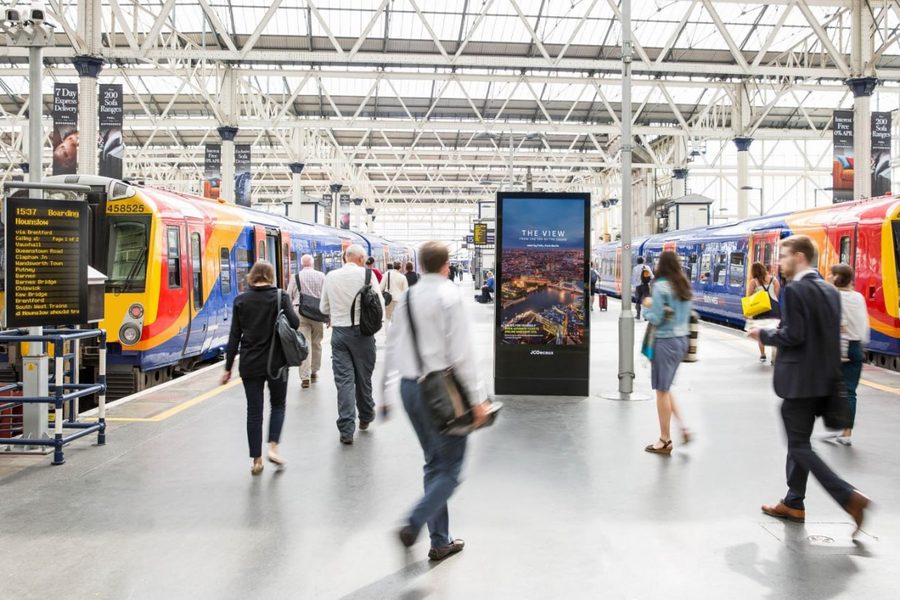
Advertising on Trains
Posters inside the carriage stay with passengers for the length of their journey. What you can book depends on the train operator and the route, so we check what each operator offers for your dates.
Carriage posters and panels
Posters inside the carriage, in front of seated and standing passengers for the whole journey. Offered by some operators on some routes.
On-train Wi-Fi adverts
Adverts shown to passengers when they connect to the train’s Wi-Fi. Offered by some operators.
Train wrap advertising
Your design on the outside of a train, seen at every station it calls at and along the line. Offered by a few operators. Design, printing and fitting are part of the plan, so allow more time.
Station or train?
Station sites catch people as they walk through and wait for their train, so a short, bold message works well. Posters inside the carriage stay in front of passengers for the whole journey, so there is time for more detail. A rail plan can use both.
On the London Underground, carriage advertising is a different product with its own seller: see Tube car panels.
Where You Can Advertise at Train Stations
Great Britain’s rail network had 2,589 stations with mainline services at 31 March 2025 (ORR). Advertising is sold at many of them, from the main termini to local stations, and we book across the network. The stations below are examples of where these formats exist, with each station’s entries and exits from April 2024 to March 2025.
Train station advertising in London
London termini such as:
- London Liverpool Street98.0 million
- London Waterloo70.4 million
- London Paddington69.9 million
- London Bridge54.7 million
- London Victoria53.8 million
- London Euston40.2 million
Regional hubs
Major stations in England, Scotland and Wales, such as:
- Birmingham New Street36.6 million
- Manchester Piccadilly27.4 million
- Leeds27.3 million
- Glasgow Central25.3 million
- Edinburgh Waverley22.8 million
- Cardiff Central12.5 million
Commuter and local stations
Smaller stations across England, Scotland and Wales, from commuter towns to city suburbs. Posters here are often sold by the month or on longer terms, which suits local businesses, recruitment and events near one station.
You can book a single station, a line, a region, or the main hubs in several cities in one plan.
Figures are entries and exits, April 2024 to March 2025, from the Office of Rail and Road’s Estimates of station usage. Station names are examples, not a promise of a particular site or date: we check what is free when you brief us.
Want roadside sites near the station as well? See billboard advertising in London, Birmingham, Manchester, Leeds, Glasgow, Edinburgh, Liverpool, Bristol, Newcastle and Sheffield.
Our campaign
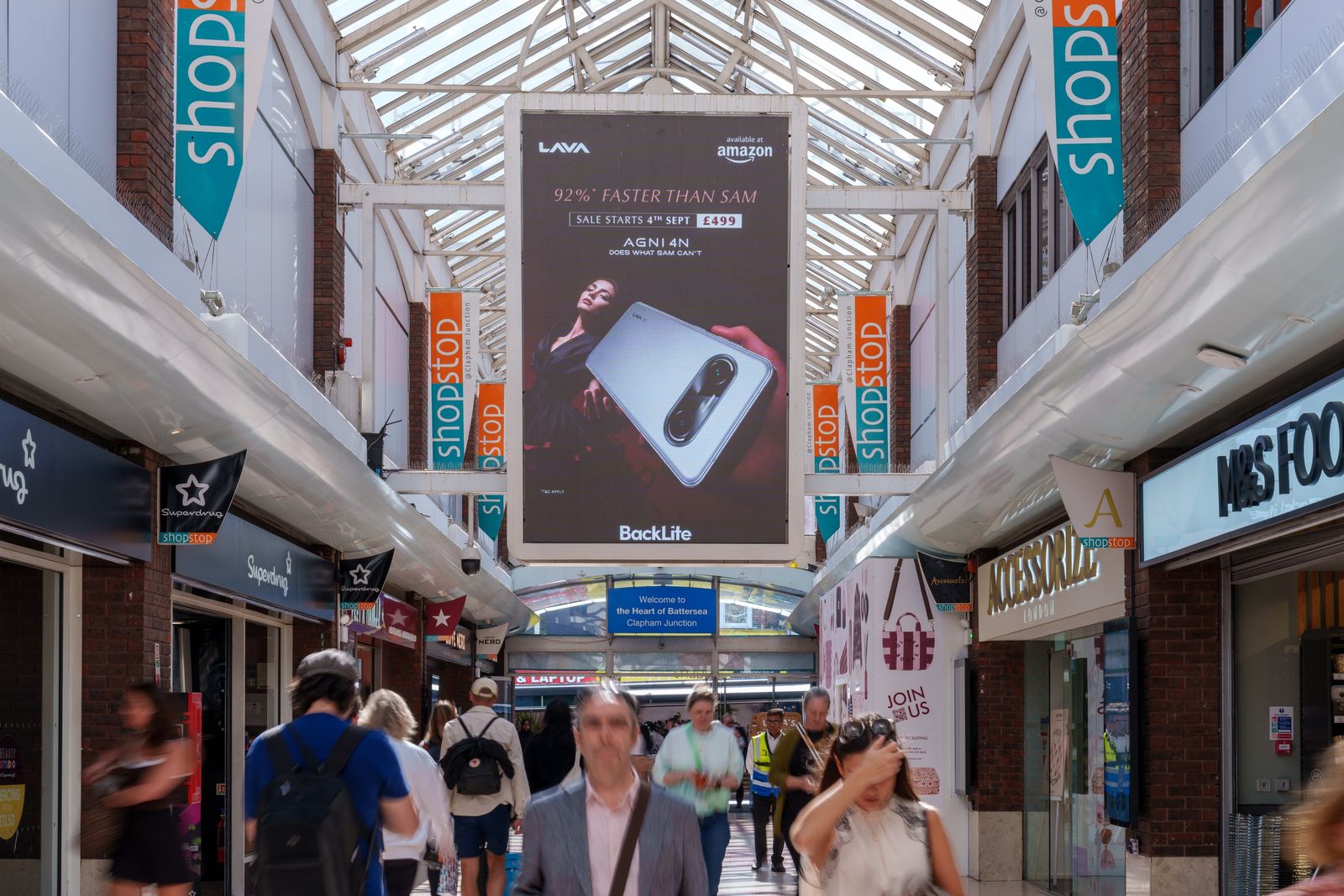
LAVA AGNI 4N at Clapham Junction
For the LAVA AGNI 4N UK launch, from 2 to 8 September 2026, we planned and booked 49 screens across London. Behind three landmark screens sat 46 portrait screens in more than 40 neighbourhoods, on from 6am to midnight. One of them hung in the station arcade at Clapham Junction, part of the screen network behind the landmarks.
Station sites can sit inside a wider city plan like this: the same person can meet the campaign on the way to work, at lunch and on the way home.
Read the LAVA AGNI 4N case study →More work: see all case studies.
How to Book Rail Advertising
Six steps from your first brief to adverts in the station, with one point of contact across every seller.
Send us your brief
Your dates, the stations, line or area you want, who you want to reach and a budget range. Not sure which stations? Tell us the audience and we suggest them.
We check availability with each seller
Station space is sold by different media companies and operators, so we check each one for your dates and ask for the sites you want to be held while you decide.
You get one proposal
One plan covering every station and format, with the dates and the price for your campaign.
Artwork and approval
We send the specification for each format. Artwork must be approved under the station’s advertising rules before it runs, so we check it against those rules first.
Print and posting, or upload
Paper posters are printed and posted before the start date. Digital artwork is uploaded to the screens.
Your campaign runs
Your adverts run for the weeks or months you booked. We send proof-of-play reports for digital screens and, where the seller supplies them, photos of your posters on site.
Lead times
Typically, allow one to two weeks for most campaigns, so the sites you want can be held for your dates. Paper posters need extra time for printing and posting before the start date.
The run-up to Christmas fills early, so book sooner then. Digital screens can go live faster when space is free and the artwork is ready to specification.
Train Station Advertising Costs: What Sets the Price
Station digital 6-sheet screens start from £690 + VAT per screen for 2 weeks, and 4-sheet posters from £160 + VAT per panel for 2 weeks, plus print. Every other format is priced on request, because prices vary by station, format and seller. These are the things that move the price, so you can see where a budget goes.
The station
Stations with more people passing through usually cost more than quieter ones.
Paper, digital or a big screen
A large concourse screen at a major terminus typically costs much more than a poster at a local station.
Share of time
On a digital screen you share the loop with other advertisers. More time on screen costs more.
How many stations or panels
One station, a whole line, a region or the main hubs in several cities.
Weeks or term
Digital is typically booked by the week or fortnight. Posters are booked by the fortnight at many stations, and by the month or longer at smaller ones. Ask us how the term changes the price.
Time of year
Busy months, such as the run-up to Christmas, are in demand and fill early.
Print, production and posting
Paper posters need printing and posting. Digital screens need no print.
Wrap design and fitting
For a train wrap: design, production and fitting, on top of the media.
Minimum orders vary by network; we confirm yours in the quote. Tell us your dates, the stations or area and a budget range, and we send a priced plan for the sites that fit. London Underground prices work differently: our Tube cost calculator covers Underground prices only, and the Tube advertising cost guide explains them.
Rules for Railway Advertising
Railway station advertising has its own approval rules on top of the usual advertising code.
- Adverts at Network Rail’s stations must follow Network Rail’s code of acceptance for commercial advertising and the UK advertising code (the CAP Code).
- Under Network Rail’s code, political adverts that call for support of a particular viewpoint, policy or action, or that attack a member or the policies of any government authority, are not approved.
- Artwork is approved before it runs, and promotional stands and sampling need the station’s permission.
- Train operators may add their own rules at the stations they run.
- We check your artwork against these rules before it goes for approval, to help avoid delays.
Source for Network Rail’s code: UK Parliament, written answer HL1997, 12 February 2024.
Rail, Tube or Bus?
This page is about National Rail. If you are planning transport advertising on another network, these pages cover it, and we can book them together from one brief.
National Rail stations and trains
Stations and trains across Great Britain: platform posters, concourse screens, large sites and on-train panels. This page.
London Underground
Tube stations, escalators, platforms and carriages in London, with their own formats and prices.
Tube advertising →Tube cost calculator (Underground prices only) →
Roadside billboards
48-sheets and roadside screens, including sites on the roads around stations.
Digital screens nationwide
Digital billboards and screens across the UK, booked on their own or with station screens.
Moving screens outside stations
A digital AdVan or AdBikes outside a station at rush hour, hired by the day or the hour.
Who Train Station Advertising Suits
Station advertising can suit any brand whose audience travels by train, from one shop near one station to a national launch.
Commuter and B2B brands
Reach office workers on the same routes, at the same times, most working days.
Launches and events
Big screens at the main stations for a week or two around a launch or event date.
Recruitment
Posters at the stations near your site, where local people travel every day.
Travel, leisure and days out
Catch people when they are already on the move and thinking about where to go next.
Universities and colleges
Stations near the campus, or along the lines students use to get there.
Local businesses
One poster or screen at your nearest station, often on a monthly or longer term.
One station or a whole network
A local business can book a poster or a screen at one station. A brand can run a whole line, a region, or the main hubs in several cities at once. Tell us who you want to reach and we suggest the stations, the formats and the mix of paper and digital.
Train Station Advertising FAQs
Station digital 6-sheet screens start from £690 + VAT per screen for 2 weeks, and station 4-sheet posters from £160 + VAT per panel for 2 weeks, plus print. Other formats, such as 6-sheet and 48-sheet posters and large concourse screens, are priced on request, because prices vary by station and format, and different stations have different sellers. The main things that set the price are the station and how many people use it, the format (a paper poster, a digital screen or a large concourse screen), your share of time on a digital screen, how many stations or panels you book, how many weeks or months you run, the time of year, and print and posting for paper posters. Minimum orders vary by network; we confirm yours in the quote. Send us your dates, the stations or area and a budget range, and we will come back with a priced plan for the sites that fit.
Advertising on trains is priced on request, and what you can book depends on the train operator. Some operators sell posters or panels inside carriages, some sell adverts on their on-board Wi-Fi, and a few offer full train wraps. The cost is set mainly by how many carriages or trains you book and for how long. A train wrap also needs design, printing and fitting, which are priced as part of the plan.
Yes. At many stations you can book a single poster or screen, which suits a local business, a recruitment drive or an event near one station. Brands often book a whole line, a region or the big hubs in several cities instead. Tell us the station and your dates, and we check what is free there.
Station posters use the standard UK poster sizes. A 4-sheet is about 1.0 m wide by 1.5 m high (portrait), a 6-sheet is 1.2 m by 1.8 m (portrait) and a 48-sheet is about 6.1 m wide by 3.0 m high (landscape). A digital 6-sheet is the screen version of a 6-sheet poster. Large concourse screens, gatelines and floor graphics vary from station to station, so we send the exact artwork specification for every site you book.
Yes. Many stations have portrait digital 6-sheet screens on platforms and concourses, and the big stations have large concourse screens. On a digital screen your advert plays in turn with other advertisers’ adverts, so you buy a share of time. Many screens can play moving artwork as well as stills, and we confirm what each screen accepts. Digital needs no printing, and the artwork can usually be changed during the campaign.
It depends on the format. Digital screens at the big stations are typically sold in 1 or 2 week periods, which suits a launch or a short burst. Posters at smaller regional stations are often sold by the month or on longer terms, such as 3, 6 or 12 months, because a printed poster is posted once and stays up. Tell us your dates and we will tell you what each station offers.
For most campaigns, allow one to two weeks so the sites you want can be held for your dates. Paper posters also need time for printing and posting, so allow longer for those. Busy times of year, such as the run-up to Christmas, fill early, so book sooner then. Digital screens can sometimes go live faster when space is free and the artwork is ready to specification.
Advertising space at stations is mostly sold by media companies under agreements with Network Rail, which runs 20 of the main stations itself, and with the train operators that run the others; some operators sell certain formats themselves. That means different stations, and sometimes different formats at the same station, have different sellers. As an outdoor advertising agency, we plan and book across them for you, so one brief can cover several stations and formats in a single proposal.
No. The London Underground is a separate network with its own stations, formats and prices. This page covers National Rail stations and trains across Great Britain. For Tube station posters, escalator panels, digital screens and carriage panels, see our Tube advertising page, and use the Tube cost calculator for Underground prices.
Adverts at Network Rail’s stations must follow Network Rail’s code of acceptance for commercial advertising and the UK advertising code (the CAP Code). Under Network Rail’s code, political adverts that call for support of a particular viewpoint, policy or action, or that attack a member or the policies of any government authority, are not approved. Train operators may add their own rules at the stations they run, and promotional stands and sampling need the station’s permission. We check your artwork against the rules before it goes for approval.
Get a Train Station Advertising Plan
Tell us your dates, the stations or area and a budget range, and we send a priced plan for the stations and formats that fit.
More Ways to Advertise
Other formats we plan and book, often alongside rail.
- Tube advertising →
- Tube digital screens →
- Tube platform posters →
- Bus advertising →
- Digital billboard advertising →
- Digital billboards in London →
- Billboard advertising →
- Shopping centre advertising →
- Taxi advertising →
- All outdoor advertising →
- What is OOH advertising? →
- Billboard types and sizes →
- LAVA AGNI 4N case study →
- All case studies →
Plan Your Train Station Campaign
One station or a whole network. Tell us your dates and area, and we send a priced plan.
*Subject to availability